▪ Week in Review PRICING CULTURE | | | Issue 009 · Monday, September 14, 2026 | | ▪ Opening Note A record-breaking $756 million total at Monterey Car Week masked a quiet, brutal divergence where everyday mid-century classics fell flat while modern hypercars soared. This stark divide in collector cars mirrors a broader structural vulnerability in the art market, where uncoordinated estate liquidations face rigid tax deadlines and sudden liquidity traps. Across both asset classes, the illusion of aggregate strength hides a highly selective pool of capital. Whether navigating the shifting brand equity of legacy electric SUVs against quicker mass-market rivals or timing a major collection sale before tax exemptions revert, success no longer belongs to the passive holder. The market is aggressively separating the truly exceptional from the merely expensive. |
| | ▪ The Big Read The story at the center of this week's market, followed far enough to see the mechanism underneath it. | ▪ CollectiblesMonterey Car Week’s Record $756M Total Masks a Deepening Divergence in the Collector Car MarketWhile modern hypercars and select prewar masterpieces drove aggregate sales to historic heights, everyday mid-century classics quietly underperformed, signaling a highly selective pool of capital. By The Pricing Culture Desk |  Source: Pricing Culture Studio | The read
Extreme concentration at the top of the market pulled total volume to historic levels while more common vintage models frequently missed condition-appropriate targets. The headline figures from the 2026 Monterey Car Week auctions suggest an unprecedented boom, with total sales reaching a record $755.6M. This massive sum surpassed the previous pandemic-fueled record high set in 2022 by some $284M. However, this top-line expansion was heavily concentrated among a small group of exceptional, nearly irreplaceable vehicles, masking a much more complicated and selective environment for the broader collector car market. At the absolute pinnacle of the market, modern low-production supercars and historically significant racing icons commanded immense premiums. A 1964 Shelby Cobra Daytona coupe led the week with a record-setting $42,905,000 sale, while a 1996 McLaren F1 GTR brought $34,655,000. This intense demand was particularly evident for modern Ferraris, where strategic buyers competed fiercely. Owning these halo assets signals brand commitment, strengthening a collector's position when the factory allocates its next ultra-exclusive models. This strategic incentive structure helped push modern supercars to exceptional heights, with a Ferrari 288 GTO selling for a record $11,555,000, an F40 reaching $8,400,000, and an F50 hitting $14,575,000. Overall, cars from the 2020s generated $147.7 million from just 53 cars. In stark contrast, the more common mid-century consignments struggled. Vehicles from the 1950s and 1960s represented over a third of the auction lots, yet they were the only two decades to post a negative median final price relative to their condition-appropriate values. Even within the historically strong 1960s segment, the market divergence was clear. While unique, low-production legends like the record-breaking Daytona Coupe and a 1963 Chevrolet Corvette Grand Sport—which sold for $18,705,000—drew spirited bidding, more common 1960s vehicles sold for a median of 6.2% below their condition-appropriate value. This indicates that familiarity alone no longer generates premium demand, and standard vintage models without external strategic incentives face a highly selective pool of capital. Meanwhile, the prewar segment showed surprising resilience and reliable saleability. Prewar cars achieved an 84% sell-through rate, the highest of any decade, with 143 cars selling for a total of $102.6 million. This segment was led by a 1935 Duesenberg Model JN Rollston Convertible Coupe that sold for $9,080,000, marking the third-highest price ever paid for a Duesenberg. Additionally, a 1934 Packard 1108 Twelve sold for a marque record of $4.3M, proving that early iron still commands real money when provenance and condition are beyond argument. The highly uneven distribution of capital also reshaped the performance of individual auction houses. RM Sotheby’s and Gooding Christie’s dominated the week, accounting for 71% of the total dollar volume and beating the entire 2022 Monterey record between them. RM Sotheby’s generated 50% of the week's money while selling 20% of the cars. In contrast, Mecum Monterey offered the largest volume of lots, bringing 521 cars and selling 328 of them, but focused on lower average prices to generate a total dollar volume of $111.4M. Sources & Notes: [1] Classic · [2] Ha · [3] Hagerty · [4] Roadandtrack · [5] Pricing Culture |
| | ▪ Secondary-Market Price Changes | | Change in tracked secondary-market list prices. Positive figures mean asking prices rose; negative figures mean they fell. | Data availability
Pricing Culture's scheduled Saturday price-index update was not complete by the time of writing. This section uses the most recent completed observations available: Watches through September 12, 2026; Cars through September 12, 2026; Handbags through September 12, 2026. | | Watches | List prices were unchanged over 90 days |
7 days
-0.02% | 30 days
+0.4% | 90 days
+0.00% |
| | Cars | List prices rose over 90 days |
7 days
-0.04% | 30 days
+1.1% | 90 days
+1.9% |
| | Handbags | List prices fell over 90 days |
7 days
-7.0% | 30 days
-0.4% | 90 days
-0.2% |
| Pricing Culture read
Across leading secondary marketplaces, average listed asking prices across the most recent completed seven-day index windows moved as follows: Watches were broadly unchanged at -0.0%, Cars were broadly unchanged at -0.0%, and Handbags fell 7.0%. These are changes in seller asking prices, not completed-sale returns. Cars led the 90-day window at +1.9%, while Handbags trailed at -0.2%. The 2.0-point gap is the cleaner measure of category rotation; 2 of 3 categories were positive over the last 30 days. |
Source: Pricing Culture Analytics | ▪ Pricing Culture Pro · One professional viewOne professional view of fragmented luxury and collectible markets.Pricing Culture brings global auction activity, luxury-brand signals, and private-wealth implications into one dashboard for professionals working on behalf of clients, principals, and stakeholders. Use Data Panels, Insights, and Reports to see what changed, why it matters, and what to watch next. | 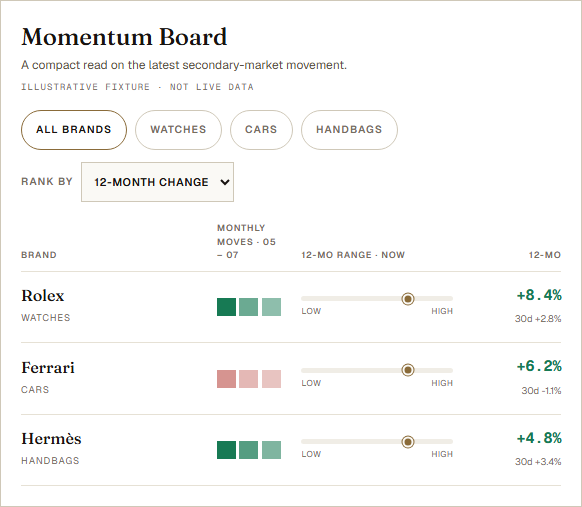 Pricing Culture Pro · Illustrative product view | Monthly membership$75/month
Annual membership$810/year· save 10% annually
Seven-day access before first payment | |
|
| ▪ CollectiblesThe Art Estate Liquidity Trap: Why Uncoordinated Succession Planning Risks Costly Forced SalesAs a massive volume of art and collectibles prepares to change hands, a lack of structured succession planning leaves estates highly vulnerable to carrying costs, beneficiary disputes, and illiquid market blockages. |  Source: Pricing Culture Studio | The read
Uncoordinated estate planning for high-value art collections risks severe liquidity blockages and forced sales during a massive intergenerational wealth transfer. The transition of high-value passion assets is accelerating as an unprecedented intergenerational transfer of wealth begins. Over the decade following 2025, an estimated $992000000000 in art and collectibles is projected to change hands. For estates holding these highly subjective and illiquid assets, the lack of early, structured succession planning can stall settlements, trigger costly disputes among heirs, and force premature liquidations. This massive wealth transfer occurs as the global art market navigates a delicate recovery. In 2025, global art sales grew by 4% year-on-year to an estimated $59600000000, reversing two consecutive years of declining values. However, this recovery remains uneven across regions and segments. Selling into a recovering but volatile market requires precise timing, which is easily disrupted when heirs disagree on whether to retain, divide, or liquidate a collection. The risk of forced sales is particularly acute given the shifting dynamics of the auction and dealer sectors. Public auction sales rose by 9% to $20700000000 in 2025, driven by record prices at the high end, such as Gustav Klimt’s Portrait of Elisabeth Lederer (1914-1916), which sold for $236000000. Yet, private sales at auction houses declined by 5% to just under $4200000000. If estates must liquidate assets rapidly to cover taxes or settle disputes, they risk selling at a steep discount in a market where liquidity is concentrated in very specific, established sectors. Tax policy shifts further compound these estate planning challenges. In 2025, the individual gift and estate tax exemption stood at $13990000, or nearly $28000000 for a couple, but it is scheduled to revert to an estimated $7000000 per person in 2026. Without proactive planning, such as utilizing the current exemption or establishing structured sales, estates face substantial tax liabilities. When heirs hold conflicting desires—with 78% of passionate collectors wanting to pass art down and 69% of heirs planning to keep it—unresolved governance and outdated valuations can quickly freeze estate liquidity. Sources & Notes: [1] Art Basel · [2] Bank of America Private Bank · [3] Deloitte · [4] Jpmorgan · [5] Pricing Culture |
| | ▪ The Auction Room | | What cleared, what sold and where the week's value concentrated. | $28.0M Total sales | 91.8% Sell-through by lot | 5,477 Lots offered |
| Pricing Culture read
12 tracked auctions closed with $28.0M in sales. Phillips Watches Online Auction: The Geneva Sessions, Fall 2026","CLOSING_SOON supplied 32.3% of the week's value. Across the full weekly tape, 5,030 of 5,477 offered lots sold, a 91.8% weighted sell-through rate. 36 more tracked auctions were underway at the cutoff. | | Sales closed in the latest week | | Phillips · Phillips Watches Online Auction: The Geneva Sessions, Fall 2026","CLOSING_SOON | $9.0M |
97 of 97 lots sold · 100.0% sell-through · $93.3K average sold lot · 32.3% of weekly tracked value | | Goldin · 2026 Summer Pop Culture Elite Auction | $8.1M |
1,713 of 1,946 lots sold · 88.0% sell-through · $4.7K average sold lot · 28.8% of weekly tracked value | | Sotheby's · Handbags & Accessories | $3.2M |
154 of 175 lots sold · 88.0% sell-through · $20.8K average sold lot · 11.5% of weekly tracked value | | Tracked auction results in the latest completed week: $28.0M across 12 auctions. |
Source: Pricing Culture Analytics | ▪ Pricing Culture Pro · One professional viewProfessional intelligence for auction, luxury, and private-wealth markets.See fragmented auction activity, luxury-brand signals, and collectible-market movement in one place. Data Panels track movement, Insights explain what changed, and Reports support deeper research and stakeholder briefings. | 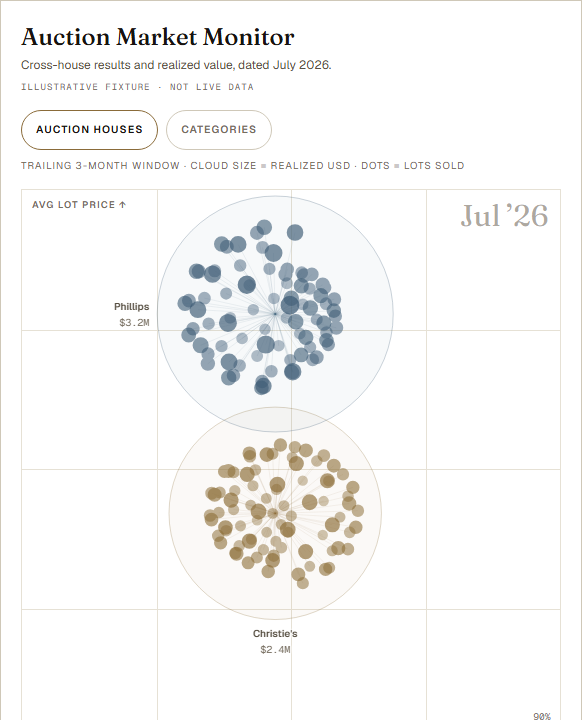 Pricing Culture Pro · Illustrative product view | Monthly membership$75/month
Annual membership$810/year· save 10% annually
Seven-day access before first payment | |
|
| ▪ CollectiblesWhy Collection Sale Timing Belongs in the Estate Plan Amid Shifting Tax ExemptionsWith an unprecedented volume of passion assets set to transfer wealth, uncoordinated liquidations risk depressing net realizable values under rigid tax deadlines as exemptions prepare to revert. |  Source: Pricing Culture Studio | The read
Uncoordinated liquidations of art collections under rigid tax deadlines risk depressing net realizable values unless structured around market cycles and shifting tax exemptions. Managing a high-value art collection requires aligning aesthetic passion with rigorous financial planning. When a collector passes away, fiduciaries often treat these holdings as static wealth, ignoring how the seasonal nature of the art market and rigid tax deadlines collide to force ill-timed sales. This friction is compounded by emotional attachment, which frequently delays cataloging, documenting provenance, and obtaining professional valuations until a transition occurs. The urgency of structured estate planning is heightened by impending regulatory shifts. The individual gift and estate tax exemption of $13990000 in effect in 2025 is scheduled to revert to an estimated $7000000 per person in 2026. For couples, the exemption of nearly $28000000 could face similar adjustments. Without proactive planning, heirs may be forced to liquidate assets rapidly to meet tax obligations, regardless of prevailing market conditions. Such forced liquidations can be devastating during market contractions. Although the global art market grew by 4% year-on-year to an estimated $59600000000, recent history shows how quickly high-end demand can contract. In 2024, weakness at the top end dragged global values down, demonstrating that high-end demand is highly cyclical. When heirs are forced to sell during a contraction to meet rigid tax deadlines, they cannot wait for a cyclical recovery. Furthermore, the structure of the sale itself dictates the tax impact. Expenses of selling can only be written off against the estate tax bill if the estate plan explicitly states which works are to be sold. This is particularly critical given that 78% of individuals with collections worth more than $100000 are passionate about passing their art to the next generation, while 69% of heirs plan to hold onto them, making clear, structured directives essential to preserve value. Sources & Notes: [1] Art Basel · [2] Bank of America Private Bank · [3] Deloitte · [4] Wealthmanagement · [5] Pricing Culture |
| ▪ CarsThe Valuation Risk of Premium Electric SUVs in an Era of Mass-Market Performance ParityThe substantial price spread between legacy luxury electric SUVs and quicker mass-market rivals highlights a shifting dynamic in brand-equity preservation. |  Source: Pricing Culture Studio | The read
The substantial price spread between legacy luxury electric SUVs and quicker mass-market rivals highlights a shifting dynamic in brand-equity preservation. The performance electric SUV segment is witnessing a significant disruption as mass-market alternatives challenge the pricing power of legacy luxury marques. Instrumented testing of the 2026 Porsche Macan GTS Electric, which carries a retail price of $107650, alongside the 2025 Hyundai Ioniq 5 N, priced at $61550, reveals a stark reality: the premium badge no longer commands a monopoly on raw performance metrics. In fact, the mass-market contender delivers quicker acceleration at a fraction of the capital outlay. This performance parity introduces substantial residual-value risk for collectors and market participants. Historically, premium marques justified high entry prices through exclusive engineering thresholds. However, the standardized nature of electric powertrains allows mass-market manufacturers to match or exceed these performance baselines. The Hyundai launches to 60 mph in 3.0 seconds flat, while the Porsche requires 3.3 seconds. This compression of the performance gap means the premium paid for the German badge represents intangible brand equity rather than a tangible performance advantage, making the asset highly vulnerable to steep secondary-market price declines. The valuation friction coincides with broader strategic shifts among European legacy brands. As manufacturers decelerate their electric rollouts, the long-term support, parts availability, and software maintenance for early-generation luxury electric SUVs remain unhedged risks. The core question is whether the secondary market will value these vehicles based on their utility and performance or on their brand heritage. While the Porsche offers superior braking, stopping from 70 mph in 148 feet compared to the Hyundai's 153 feet, the massive capital outlay difference raises the hurdle for capital preservation. Ultimately, the available transaction data does not yet show whether the luxury badge can insulate the asset from the steep value erosion typical of early-adoption technology. The Macan GTS Electric tested, with an as-tested price of $123200, features options like the GTS Interior package for $6570 and rear-axle steering for $2150. Meanwhile, the Ioniq 5 N base price of $67475 shows that high-performance electric mobility is accessible without the steep premium, leaving the long-term residual value curve of these performance electric SUVs unresolved. Sources & Notes: [1] Caranddriver · [2] Reuters · [3] Pricing Culture |
| | ▪ On the Wires | Steve McQueen's Ferrari 275 GTB/4 NART Spyder Set for Public Auction Debut Pricing Culture summary
A 1967 Ferrari 275 GTB/4 NART Spyder originally delivered new to Steve McQueen is making its public auction debut at the Gooding Christie's inaugural Rétromobile New York sale with an estimate of $15 million to $20 million. This highly coveted chassis, which has remained in the same private collection for 40 years, represents a monumental market moment as the first time it has ever been offered at public auction. | Princess Diana's Original "Revenge Dress" Headed to Sotheby's Auction in New York Pricing Culture summary
Princess Diana's famous Christina Stambolian "revenge dress" will be offered at auction at Sotheby's in New York on December 9, 2026, with an estimated value of $150,000 to $300,000. The sale marks the return of one of the most recognizable late-20th-century royal fashion pieces to the public market for the first time in nearly three decades. | Rolex to Auction Four Unique Gem-Set Daytona Watches for Charity Pricing Culture summary
Rolex is partnering with Phillips to auction four unique, one-of-one gem-set Daytona watches inspired by the seasons in London on September 28, with proceeds benefiting the Federer Foundation and Re:wild. The sale represents a world first of completely unique Daytona models for the brand, with expectations that the individual lot format could drive the total past double the initial £4 million set estimate due to high demand. | Phillips Schedules The Geneva Sessions Fall 2026 Watch Auction Pricing Culture summary
Phillips Geneva has scheduled its Fall 2026 online watch auction, titled The Geneva Sessions, to run from September 4 to September 11, 2026. The online sale represents a key scheduled event for the high-end horology market, featuring a viewing period in early September ahead of the bidding close. |
| | ▪ One More Thing Founder's Note Please Keep the Notes ComingOver the past few months, many of you have taken the time to send notes, corrections and requests. I appreciate every one of them. They have helped sharpen what Pricing Culture should do best: make fragmented markets easier to see and compare. We are excited to keep building reporting and tools for readers who follow art, collectibles and other cultural assets. Please reply and tell me what would make the Auction Market Reports more useful: the houses, categories, comparisons or questions you would like us to examine next. B.
@pricingculture | PRICING CULTURE Reporting and data for cultural-asset markets Pricing Culture covers the markets for cultural assets: auctions, secondary-market moves, brand signals, and the stories shaping value, provenance, and trade. We organize a fragmented market with reporting, data, and disciplined source work. Front Page · Secondary Markets · The Wire · Auction Rooms Pricing Culture Inc. · Week in Review |
|
