▪ Week in Review PRICING CULTURE | | | Issue 011 · Sunday, September 27, 2026 | | ▪ Opening Note One California jewelry sale this week offered a useful correction to the usual top-lot headline: most of its recorded dollars came from the middle of the sold-price distribution. That question of what a result really represents follows us into a Bonhams art room, while Prada gives a runway collection a single, changeable grammar and Christie's builds a global specialist team for pop culture. The market panel below uses the latest available asking-price observations, each dated separately. |
| ▪ The Big ReadThe middle of a California jewelry sale carried the resultBonhams sold 175 of 216 lots; 116 modestly priced pieces supplied most of the recorded value. |  Source: Pricing Culture Studio | The read
The upper end drew the eye, but the five-figure-and-below middle supplied the sale's weight. The useful number in Bonhams' Fine Jewelry: California sale sits near the middle. Of 175 sold lots, 116 brought between $5,000 and $19,999 apiece. Together they contributed $1,069,056 of the September 25 sale's $1,545,984 recorded total. That broad group, rather than its few most expensive pieces, carried most of the value. The official sale record lists 216 offered lots: 175 sold and 41 bought in. Reported clearance was 81.0%. The recorded sold prices include buyer's premium, and the total here is the sum of those same sold-lot prices. Catalog breadth and result concentration are separate questions. The median sold price was $7,040. Forty-nine sold lots brought less than $5,000 and together contributed $175,488. Ten lots reached at least $20,000, adding $301,440. Between them sat the 116-lot middle, about 69% of recorded dollars. This is a distribution of completed sales, not a reading of asking prices. The highest recorded lot, a platinum, sapphire and diamond convertible ring, brought $53,760. A David Webb bracelet and a gold jewelry suite each brought $40,960. Those are useful highlights, but they describe the edge rather than the typical transaction. The ten highest-price-band lots supplied about one-fifth of the total; the middle band supplied more than two-thirds. That contrast makes the sale more legible than a top-lot anecdote. There were standout objects, but the cumulative demand for smaller pieces did most of the work. The briefing therefore has two parts: 175 of 216 lots cleared, and the center of sold prices supplied the value. The lot distribution is a better guide to this session's shape than the most photogenic jewel in its catalog. Sources & Notes: [1] Bonhams sale results · [2] Bonhams ring lot · [3] Bonhams David Webb lot |
| | ▪ Secondary-Market Price Changes | | Change in tracked secondary-market list prices. Positive figures mean asking prices rose; negative figures mean they fell. | Data availability
Latest available asking-price observations, dated on each row. Cars cover seven of eight tracked brands. The watch 90-day comparison is unavailable because its constituent set changed; car and handbag 30-day comparisons span 29 days to the nearest available observation. | | Watches · 20 Sep | 90-day comparison unavailable |
7 days
+0.00% | 30 days
+1.3% | 90 days
- |
| | Cars · 27 Sep | List prices rose over 90 days |
7 days
+0.1% | 30 days
+0.5% | 90 days
+2.0% |
| | Handbags · 27 Sep | List prices fell over 90 days |
7 days
+0.3% | 30 days
-0.3% | 90 days
-1.5% |
| Pricing Culture read
Listed asking prices were broadly steady over seven days. Cars rose 2.0% over their comparable 90-day span while handbags fell 1.5%; the watch series is older and its 90-day movement is withheld. These are secondary listing signals, not auction results. |
Source: Pricing Culture Analytics | ▪ Pricing Culture Pro · One professional viewOne professional view of fragmented luxury and collectible markets.Pricing Culture brings global auction activity, luxury-brand signals, and private-wealth implications into one dashboard for professionals working on behalf of clients, principals, and stakeholders. Use Data Panels, Insights, and Reports to see what changed, why it matters, and what to watch next. |  Pricing Culture Pro · Illustrative product view | Monthly membership$20/month
Annual membership$216/year· save 10% annually
Seven-day access before first payment | |
|
| ▪ The RunwayPrada builds a collection around the skirtOne garment type runs through 63 looks; materials and construction keep the range from repeating itself. | 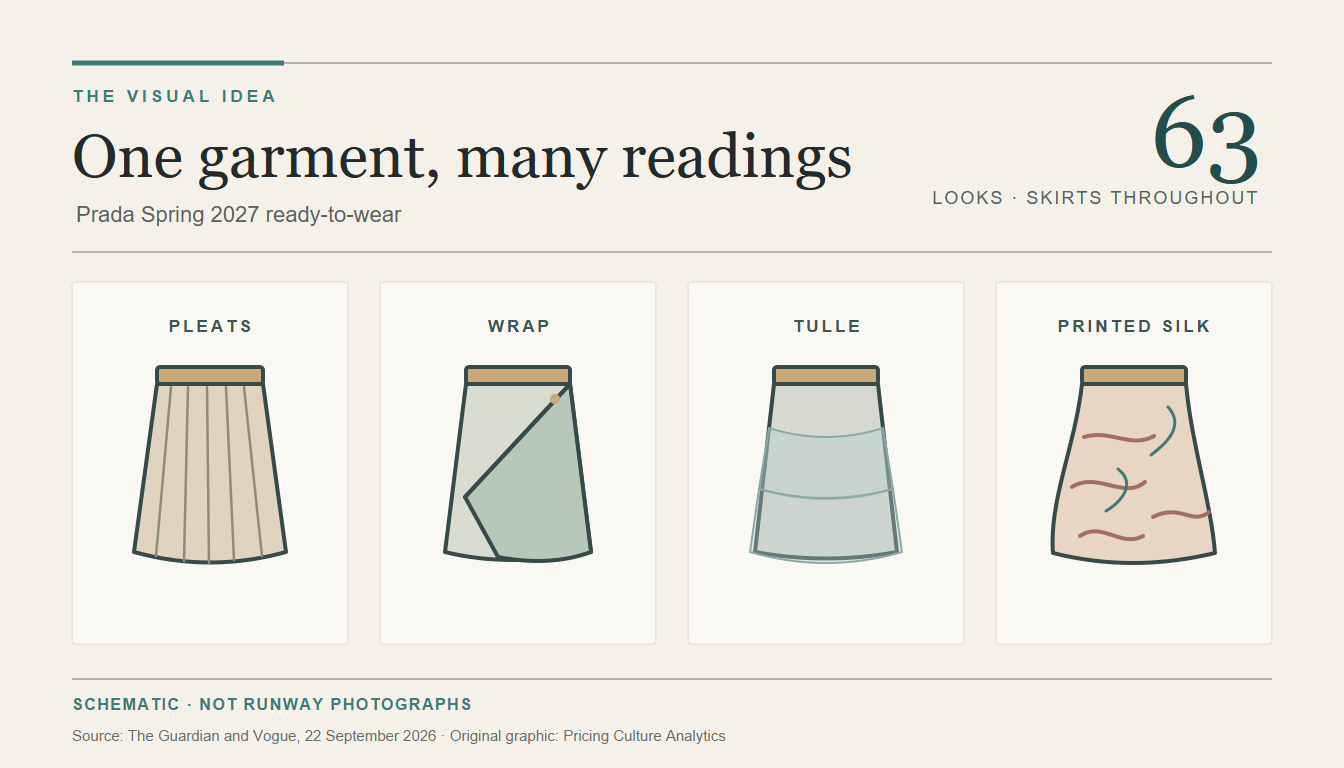 Source: Pricing Culture Analytics | The read
A single category becomes a design grammar, not a single silhouette. Prada's spring 2027 show used a familiar garment as its organizing idea: the skirt remained constant while shape, fabric and styling changed around it. The result was more specific than a general return to feminine dressing. It gave the collection a recognizable through-line without making each look a variation of the same outfit. The Guardian's September 22 report counted a skirt in each of 63 looks, with no trousers or dresses. Its account describes A-line and knee-length shapes alongside polka-dot slips, tulle, leather pleats and printed silk. Repetition of the garment did not erase the distinctions among the looks. Vogue's review describes Miuccia Prada and Raf Simons working with wraps, embellished fastenings, ribbons, crinoline and coated cotton. The skirt operated as a surface for construction ideas as much as a fixed silhouette. What changed from look to look was often its treatment rather than its presence. ELLE's September 22 account adds the styling frame: bra tops, button-downs, sweaters and jackets met skirts ranging from restrained pleats to elaborate surfaces. The collection offered both a recurring visual cue and a substantial assortment beneath it; no sales outcome follows from the runway alone. Sources & Notes: [1] The Guardian · [2] Vogue · [3] ELLE |
| | ▪ The Auction Room | | What cleared, what sold and where the week's value concentrated. | $11.4M Five-sale sample, USD equivalent | 73.3% Four Bonhams catalogues sold by lot | 61.8% British art share of Bonhams sample |
| Pricing Culture read
The British Impressionist sale supplied most of these four Bonhams catalogues' value, while their combined lot clearance was just over seven in ten. The Hong Kong watch result lifts the five-sale dollar sample, but its results listing is excluded from the clearance calculation. | | Sales closed in the latest week | | Bonhams · Fine Jewelry: California | $1.5M |
175 of 216 lots sold · 81.0% sell-through · $8.8K average sold lot · 13.5% of weekly tracked value | | Bonhams · Old Master Paintings | $450K |
72 of 123 lots sold · 58.5% sell-through · $6.2K average sold lot · 3.9% of weekly tracked value | | Bonhams · 19th Century and British Impressionist Art | $3.8M |
59 of 78 lots sold · 75.6% sell-through · $64.0K average sold lot · 33.1% of weekly tracked value | | Bonhams · Online Jewellery, London | $342K |
114 of 156 lots sold · 73.1% sell-through · $3.0K average sold lot · 3.0% of weekly tracked value | | Tracked auction results in the latest completed week: $11.4M across 5 auctions. | | Five verified sales in this selected sample, not a comprehensive market total; USD equivalents use each recorded sale-date FX rate. | | The four rows above are the Bonhams catalogues. Sotheby's Hong Kong Fine Watches adds $5.30m to the five-sale sample; its results listing is excluded from the lot-clearance calculation. |
Source: Pricing Culture Analytics | ▪ Pricing Culture Pro · One professional viewProfessional intelligence for auction, luxury, and private-wealth markets.See fragmented auction activity, luxury-brand signals, and collectible-market movement in one place. Data Panels track movement, Insights explain what changed, and Reports support deeper research and stakeholder briefings. |  Pricing Culture Pro · Illustrative product view | Monthly membership$20/month
Annual membership$216/year· save 10% annually
Seven-day access before first payment | |
|
| ▪ The Auction FileOne moonlit landscape set the pace at BonhamsThe British Impressionist sale made £2.85 million with 59 of 78 lots sold; its leading result outran estimate. |  Source: Pricing Culture Studio | The read
The headline price matters alongside the sale's 75.6% lot clearance and the results below it. Bonhams' 19th Century and British Impressionist Art sale closed September 23 with £2,845,660 in recorded sales. Fifty-nine of 78 offered lots sold, a 75.6% clearance rate. That result stands apart from the California jewelry session: a smaller catalogue, an art-led total and a different distribution of bidding. Ivan Konstantinovich Aivazovsky's moonlit landscape was the most visible price. It brought £635,400, including buyer's premium, against a £120,000–£180,000 pre-premium estimate. Those figures use different bases, but the recorded sale price still clearly outran the estimate; one work made a large contribution without defining the whole sale. Other sold paintings show the room's range. The published sale file records £190,900 for Sir Alfred Munnings's portrait of Waldorf Astor, below its £200,000–£300,000 estimate. It also keeps an offered work with no displayed result separate from the sold lots; an empty result is not a price to fill in. The 58 other successful lots supplied the remaining value beneath the Aivazovsky headline. A 75.6% sell-through rate shows that many objects found buyers, while 19 did not. Those counts keep the single standout price in proportion: it demonstrates competition for that work, not a uniform revaluation of every painting in the room. Sources & Notes: [1] Bonhams sale record · [2] Bonhams Aivazovsky lot · [3] Pricing Culture sale file |
| ▪ The Business of CollectingChristie's builds a global specialist team for pop cultureJosh Benesh will lead a global team and multiple annual sales across entertainment, sport and design. | 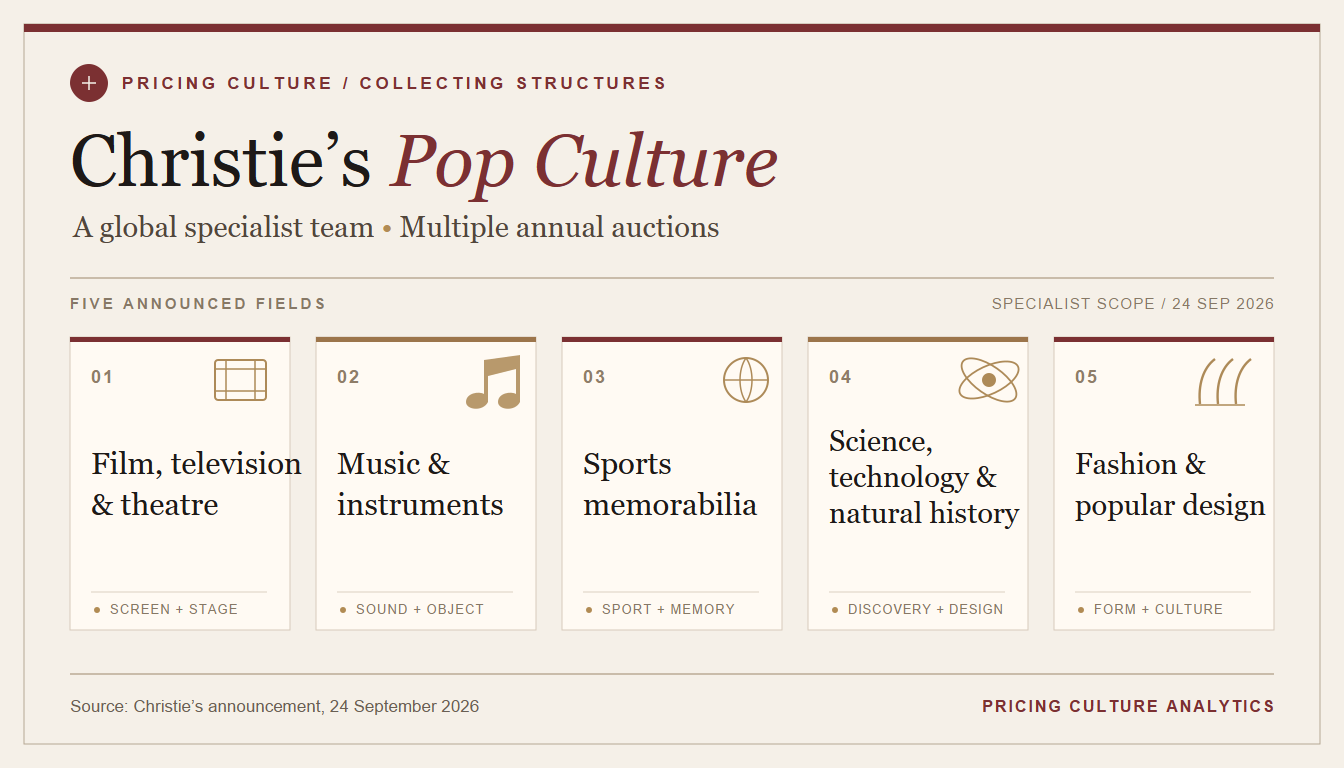 Source: Pricing Culture Analytics | The read
The appointment pairs a named leader with an international team and multiple annual sales. Christie's has appointed Josh Benesh global head of Pop Culture, based in New York. Its September 24 announcement says an international specialist team will hold multiple annual sales. The planned scope runs from film, television and music to sports, science, fashion and popular design. Benesh previously served as Heritage Auctions' chief strategy officer and general counsel. That experience now anchors a specialist program spanning objects that require very different knowledge: film props, instruments, sports memorabilia and fashion. The announced multiple-sale cadence gives that program a recurring place in Christie's calendar. Hyperallergic's September 24 report places the new division alongside the house's Jim Irsay collection sales. The specialist appointment is the new development; the earlier collection shows the kind of cross-category material already passing through the house. The organizational question is whether a continuing team can connect those categories through consistent cataloguing, consignments and bidder relationships. Christie's has announced the team and its scope. Completed sales will show how that plan works in practice. Sources & Notes: [1] Christie's Press · [2] Hyperallergic |
| | ▪ On the Wires | Bentley unveils its first fully electric model Pricing Culture summary
Bentley unveiled the Torcal as its first fully electric model at a London debut. The project includes a new production line in a building dating from 1938. | Fendi's Milan show draws on Raffaella Carrà Pricing Culture summary
Maria Grazia Chiuri took Italian pop star Raffaella Carrà as a reference for her Fendi collection. Dresses, lace bras and vintage fur stoles carried that reference through the Milan show. | Cooper Flagg debut-patch card sells for $8.04 million Pricing Culture summary
A one-of-one Cooper Flagg debut-patch autograph card sold for $8.04 million through Fanatics Collect. The report says that is the highest public price for a single-player basketball card. | A Hockney dog painting heads to auction Pricing Culture summary
The Guardian reports that Dog Painting 17, a 1995 portrait of Stanley, is estimated at £1.5m–£2.5m for an October 14 Christie's sale. Its rarity lies in the small number of Dog Series works in private hands, rather than a prior public price for this painting. |
| | ▪ One More Thing Founder's Note Look beyond the top lotThis week's California result is a reminder to look at the middle of a sale, not only its most photogenic object. We want these Sunday notes to make the shape of a market easier to see without losing the objects that make it worth following. If one comparison would make this email more useful to you, please reply and tell me what it is. B.
@pricingculture | PRICING CULTURE Reporting and data for cultural-asset markets Pricing Culture covers the markets for cultural assets: auctions, secondary-market moves, brand signals, and the stories shaping value, provenance, and trade. We organize a fragmented market with reporting, data, and disciplined source work. Front Page · Secondary Markets · The Wire · Auction Rooms Pricing Culture Inc. · Week in Review |
|
