▪ Week in Review PRICING CULTURE | | | Issue 006 · Sunday, August 23, 2026 | | ▪ Opening Note A $4.7 million Ferrari Monza SP2 sits impounded on a London street while a bespoke $40 million electric Ferrari Luce shatters records at auction, exposing a stark truth about modern luxury: value is entirely hostage to geography and regulation. Whether it is Sotheby’s anchoring a new transactional hub in Abu Dhabi with a billion-dollar sovereign backing, or thieves discovering that stolen eighty-one-million-dollar Renaissance masterpieces yield zero liquidity on the open market, the global asset map is fracturing. Ownership is no longer the ultimate prize; navigating the physical and legal friction of where these assets can actually trade is the new battleground. |
| | ▪ The Big Read The story at the center of this week's market, followed far enough to see the mechanism underneath it. | ▪ CollectiblesThe Messina Heist: Why an $81M Renaissance Theft Yields Zero Liquidity in the Open MarketThe brazen theft of rare Antonello da Messina masterpieces from a Sicilian museum highlights the stark divergence between theoretical appraisal values and the absolute illiquidity of stolen cultural assets. By The Pricing Culture Desk |  Source: Pricing Culture Studio | The read
The theft of Antonello da Messina masterpieces in Sicily demonstrates that while museum-quality Renaissance art carries immense theoretical valuation, its illicit status renders it entirely unmarketable outside of underground collateral networks. The brazen theft of rare Renaissance masterpieces from the Museo Regionale di Messina in Sicily has exposed the severe security vulnerabilities of regional institutions holding highly illiquid cultural assets. On Saturday evening, August 15, 2026, thieves managed to infiltrate the museum and escape with four works attributed to the master painter Antonello da Messina, a towering figure of the Italian Renaissance. The heist was executed with precise timing, capitalising on the Ferragosto holiday celebrations marking the feast of the Assumption of Mary. As massive crowds gathered across town for the traditional procession, local security forces and public attention were drawn away from the museum. The thieves bypassed the museum's alarm and security systems just before 10 p.m. to access the highly prized collection. Once inside, the perpetrators targeted the San Gregorio Polyptych, a historic altarpiece dated to 1473, and a double-sided devotional panel depicting the Virgin Mary and the dead Christ in Pietà. Although the thieves removed all five panels of the San Gregorio Polyptych from their frame, they abandoned two behind a wall while fleeing, ultimately escaping with four distinct pieces, including the double-sided panel which was pried from an armored display case. The financial valuation of the stolen works is extraordinary, with estimates placing their worth between 70 million euros and 80 million euros, or approximately $81 million to $92 million. This represents a massive loss of public investment, particularly considering the double-sided panel alone was acquired by the Sicilian government in 2003 for $300,000. Legitimate market interest in Antonello's work had recently intensified after Italy's Culture Ministry acquired his devotional painting "Ecce Homo" for $14.9 million through Sotheby's in New York. Beyond their monetary appraisal, the stolen works carry irreplaceable provenance and cultural significance. The San Gregorio altarpiece is celebrated as the only surviving work by Antonello da Messina to remain in his native city, having miraculously survived the devastating 1908 Messina earthquake that destroyed the monastery for which it was originally commissioned. Its removal deprives the city of the very essence of its greatest historical artist. Despite the high theoretical valuations, the illicit status of these masterpieces renders their fair market value effectively zero. Because these works are instantly recognizable, any attempt to liquidate them through reputable art market channels is impossible. Instead, stolen assets of this caliber typically circulate within the criminal underworld, serving as frozen assets used primarily as collateral for other illicit transactions rather than being sold to legitimate collectors. Sources & Notes: [1] Apnews · [2] Nypost · [3] Nytimes · [4] The Guardian · [5] Pricing Culture |
| | ▪ Secondary-Market Price Changes | | Change in tracked secondary-market list prices. Positive figures mean asking prices rose; negative figures mean they fell. | | Watches | List prices fell over 90 days |
7 days
-0.2% | 30 days
+0.1% | 90 days
-0.1% |
| | Cars | List prices rose over 90 days |
7 days
+0.04% | 30 days
+0.5% | 90 days
+0.7% |
| | Handbags | List prices fell over 90 days |
7 days
-0.05% | 30 days
-0.8% | 90 days
-0.3% |
| Pricing Culture read
Across leading secondary marketplaces, average listed asking prices over the latest seven-day window moved as follows: Watches fell 0.2%, Cars were broadly unchanged at +0.0%, and Handbags were broadly unchanged at -0.0%. These are changes in seller asking prices, not completed-sale returns. Cars led the 90-day window at +0.7%, while Handbags trailed at -0.3%. The 1.0-point gap is the cleaner measure of category rotation; 2 of 3 categories were positive over the last 30 days. |
Source: Pricing Culture Analytics | ▪ Pricing Culture Pro · Secondary MarketsSee the movement behind the market.Track changes in listed asking prices across watches, cars and handbags, compare brands over multiple windows, and see which moves are broadening, reversing or holding. | 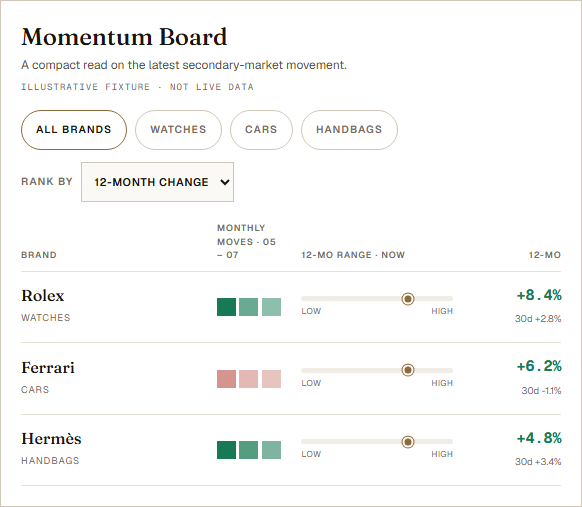 Pricing Culture Pro · Illustrative product view | Regular membership$75/month
Founding Member Pricing · Ending Soon
$37.50/monthor $405/year · save 10% annually | |
|
| ▪ WatchesSotheby’s Abu Dhabi Expansion Signals a Structural Realignment of Global Luxury CapitalBy establishing a physical marquee auction footprint on Saadiyat Island, Sotheby’s is transforming the Gulf from an outbound capital source into a primary transactional hub, backed by a $1 billion sovereign investment. | 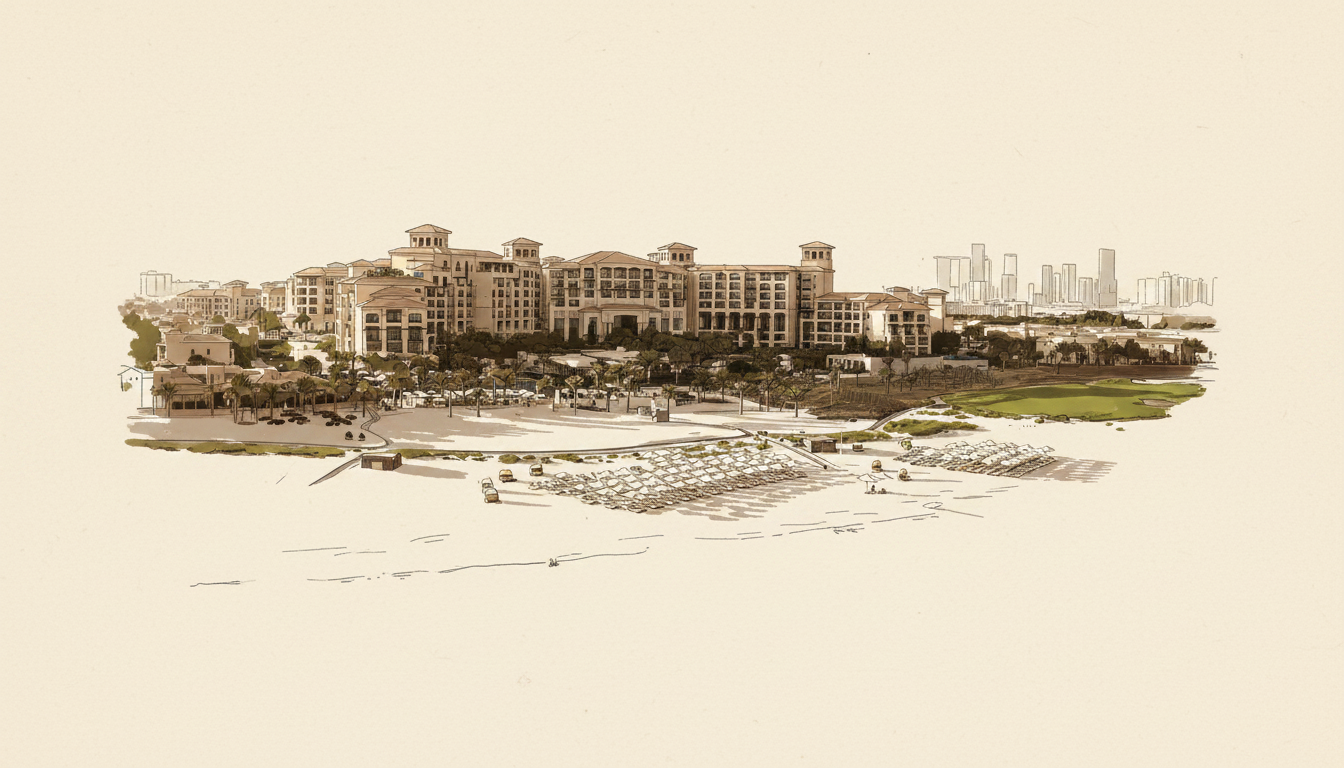 Source: Pricing Culture Studio | The read
Establishing physical marquee sales in Abu Dhabi allows Sotheby's to capture localized Gulf liquidity directly, leveraging regional cultural infrastructure and a $1 billion sovereign wealth injection. The expansion of physical auction footprints into the Middle East marks a structural shift in how global passion assets are allocated and traded. By establishing a dedicated series of luxury marquee auctions in Abu Dhabi, the traditional flow of outbound capital from the Gulf is being redirected into a localized, primary transactional hub. This strategic positioning allows for the direct capture of regional liquidity, bypassing the historical reliance on Middle Eastern buyers traveling to established Western market centers like London, Geneva, or New York. The commercial calendar is highly deliberate, aligning high-value asset transactions with major regional events to minimize transactional friction. Staging these physical sales at the St. Regis Saadiyat Island Resort places them alongside the Abu Dhabi Grand Prix, the Milken Institute Middle East and Africa Summit, Abu Dhabi Finance Week, and Bitcoin MENA. This integration reduces the logistical hurdles of international transport and import duties for local collectors while capitalizing on a concentrated gathering of global capital. Saadiyat Island itself provides a powerful institutional backdrop, housing the Louvre Abu Dhabi alongside the upcoming Guggenheim Abu Dhabi and Zayed National Museum. This dense concentration of cultural capital elevates the commercial environment, appealing to collectors who view high-value acquisitions through the lens of long-term asset preservation. The physical sales are supported by digital offerings, such as the Abu Dhabi Collectors’ Edit: Materiality, which carried a combined estimate of $6,600,000 to $9,700,000 across a curated selection of collector pieces. This regional pivot is underpinned by deep financial ties and shifting corporate strategies. Sotheby's recently secured a $1 billion cash injection from the Abu Dhabi-based sovereign wealth fund ADQ, helping to clear its books and fund its evolution into a global luxury brand. With consolidated luxury sales topping $2 billion in 2024—representing a third of its total business—the auction house is increasingly relying on high-value luxury assets, such as the 2017 Pagani Zonda 760 Riviera estimated at $9.5 million to $10.5 million, to drive growth amid a broader slowdown in the fine art market. Sources & Notes: [1] Artnews · [2] Watchpro · [3] Pricing Culture |
| | ▪ The Auction Room | | What cleared, what sold and where the week's value concentrated. | $167.3M Total sales | 63.8% Sell-through by lot | 95.2% Weekly value in the top sale |
| Pricing Culture read
9 tracked auctions closed with $167.3M in sales. Pebble Beach Auctions supplied 95.2% of the week's value. Across the full weekly tape, 2,745 of 4,304 offered lots sold, a 63.8% weighted sell-through rate. 17 more tracked auctions were underway at the cutoff. | | Sales closed in the latest week | | Gooding Christie's · Pebble Beach Auctions | $159.2M |
159 of 169 lots sold · 94.1% sell-through · $1.0M average sold lot · 95.2% of weekly tracked value | | Christie's · Summer Reverie: Chinese Paintings Online | $2.9M |
177 of 193 lots sold · 91.7% sell-through · $16.4K average sold lot · 1.7% of weekly tracked value | | Goldin · 2026 Weekly Auction Aug 11 - Aug 20 | $2.1M |
836 of 846 lots sold · 98.8% sell-through · $2.5K average sold lot · 1.2% of weekly tracked value | | Tracked auction results in the latest completed week: $167.3M across 9 auctions. |
Source: Pricing Culture Analytics | ▪ Pricing Culture Pro · Auction MarketsThe auction market, while it is still moving.Follow cross-house results, realized value, lots sold and sell-through in one view, then move from the weekly signal into the underlying sale and category data. | 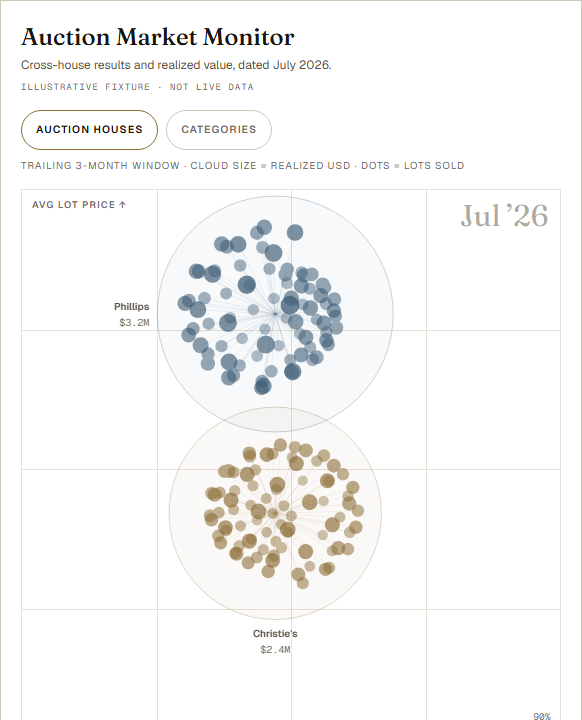 Pricing Culture Pro · Illustrative product view | Regular membership$75/month
Founding Member Pricing · Ending Soon
$37.50/monthor $405/year · save 10% annually | |
|
| ▪ CarsFerrari’s First EV Fetches $40 Million at Charity Auction Amid Deepening Collector SkepticismThe bespoke Ferrari Luce chassis 0, designed with input from Sir Jony Ive, achieved a record-breaking $40 million at an RM Sotheby's charity auction, far exceeding its standard retail price despite dividing brand enthusiasts. |  Source: Pricing Culture Studio | The read
The record-breaking $40 million sale of the Ferrari Luce chassis 0 reflects philanthropic premium and extreme rarity rather than a sustainable commercial valuation for electric supercars. The historic $40 million sale of Ferrari's first fully electric vehicle, the Luce, at Monterey Car Week represents a highly asset-specific philanthropic transaction rather than a reliable price-discovery benchmark for the broader electric vehicle market. While the transaction generates substantial capital for charitable initiatives, the extreme premium paid reflects the non-commercial dynamics of charity auctions rather than a sustainable valuation baseline for electric supercars. This result provides little guidance on how collectors will value electric powertrains when standard commercial terms apply, offering scant evidence of broader transaction depth. Staged by RM Sotheby's on August 15, 2026, the bespoke vehicle achieved a hammer price of $40 million, far exceeding the standard retail price of roughly $630,000 to $640,000. The result surpassed the previous new-car auction record set in 2025, when a bespoke Ferrari Daytona SP3 raised $26 million for educational initiatives. The buyer of the record-setting Luce is expected to take delivery of the car in 2027, whereas broader deliveries of the standard Luce model to customers are due to begin in the fourth quarter of 2026. The transaction isolates the premium of the very first production chassis, chassis number 0, offered in a unique "Tailor Made" configuration. Designed with input from former Apple design chief Sir Jony Ive, the vehicle features a custom white finish, special wheels, and bespoke brakes that distinguish it from standard production models. The sale occurred amid market skepticism and negative initial reactions to the design of the electric model, which standardizes retail pricing from a much lower base. This contrast demonstrates the divergence between public market sentiment and the behavior of ultra-high-net-worth buyers in philanthropic settings, where unique design provenance and charitable giving override standard commercial considerations. This transaction occurs during a period of transition for the Italian marque, whose move into electric motoring has divided opinion. The Luce's launch triggered criticism from some Ferrari enthusiasts and prominent Italian figures who argued that its styling and five-seat layout moved too far from the marque's established identity. Ferrari's shares fell the day after the unveiling, highlighting the commercial sensitivity of the transition. The steady performance of traditional assets illustrates the divergence between standard market liquidity and the singular, high-profile charity results achieved in California, where philanthropic intent alters standard bidding behavior. Sources & Notes: [1] BBC · [2] CNBC · [3] Financial Times · [4] Robb Report · [5] Pricing Culture |
| ▪ HandbagsLondon’s $10 Million Supercar Seizure Exposes the Regulatory Friction of Global Vehicle TransitA record-setting weekend crackdown in London’s most affluent neighborhoods highlights the growing operational and compliance risks for international collectors moving ultra-rare assets across borders. |  Source: Pricing Culture Studio | The read
The record-setting seizure of a $4.7 million Ferrari Monza SP2 in London underscores the critical compliance and operational risks that international collectors face when operating exotic vehicles abroad. The seasonal migration of exotic machinery to London’s most exclusive enclaves has met an unprecedented regulatory wall. Over a single weekend, the Metropolitan Police impounded 90 vehicles valued collectively at $10 million across Hyde Park, Kensington, and Chelsea. This aggressive enforcement action represents the highest volume and value of vehicles impounded since the department initiated its targeted crackdown on antisocial driving five years ago, signaling a sharp escalation in local policing tactics. Among the seized assets was a highly coveted Ferrari Monza SP2, a roofless speedster limited to just 499 units globally and capable of commanding nearly $5 million at auction. The vehicle had reportedly been in the United Kingdom for only a few hours before being impounded. Authorities discovered the vehicle was being operated without valid local insurance by a driver holding only a provisional license—a permit strictly reserved for those learning how to drive. For international collectors who routinely transport high-value vehicles across borders, the incident serves as a stark warning regarding the complexities of local compliance. In the United Kingdom, driving without valid insurance is a strict liability offense that triggers immediate vehicle seizure. While standard international transit policies typically cover physical damage during shipping, they rarely extend to road use in foreign jurisdictions unless explicitly endorsed with local liability coverage. The administrative friction of retrieving an impounded vehicle in a foreign jurisdiction can be immense. Owners must present proof of ownership, a valid driver's license, and specialized insurance that explicitly covers release from an impound lot—a clause standard policies frequently exclude. For an asset as delicate and rare as a Monza SP2, the primary concern is not the accumulating daily storage fees, but the physical security and handling risks associated with municipal towing and storage facilities. Sources & Notes: [1] cbsnews.com · [2] Roadandtrack · [3] Pricing Culture |
| | ▪ On the Wires | Shelby Cobra Daytona Coupe Sets Record as Most Expensive American Car Ever Sold at Auction Pricing Culture summary
A 1965 Shelby Cobra Daytona Coupe, chassis CSX2300, sold for over $25 million at the 22nd Gooding Christie's Pebble Beach auction, becoming the most expensive car the auction house has ever sold. The historic Ford-powered racer outperformed modern exotics to become the week's most expensive vehicle and the highest-priced American car in auction history. | 2026 Monterey Car Week Auctions Hit Record $755.6M Amid Stark Market Divergence Pricing Culture summary
The 2026 Monterey Car Week auctions achieved a record-breaking $755.6 million in total sales, driven by extraordinary results for modern supercars and rare classics while more common models underperformed. The results reveal an increasingly stark structural divide in the collector car market, where irreplaceable, low-production vehicles command massive premiums while common 1950s and 1960s models struggle to meet condition-appropriate values. | 1963 Chevrolet Corvette Grand Sport Sells for $18.7 Million at RM Sotheby's Pricing Culture summary
A 1963 Chevrolet Corvette Grand Sport, Chassis 003, sold for a final hammer price of $18,705,000 at RM Sotheby's Monterey auction. The sale establishes a new high-water mark for Corvette sales and makes the vehicle the third-most valuable American car ever sold at auction. | Drake Reveals One-of-One Factory Rolex 'Ice Gradient' Daytona Pricing Culture summary
Musician Drake revealed a factory-made, one-of-one Rolex 'Ice Gradient' Daytona crafted to celebrate record-breaking milestones of 2026. The public reveal of a factory piece-unique Rolex and its official documentation sheds light on an ultra-exclusive, highly secretive tier of custom watch commissioning. |
| | ▪ One More Thing Founder's Note Please Keep the Notes ComingOver the past few months, many of you have taken the time to send notes, corrections and requests. I appreciate every one of them. They have helped sharpen what Pricing Culture should do best: make fragmented markets easier to see and compare. We are excited to keep building reporting and tools for readers who follow art, collectibles and other cultural assets. Please reply and tell me what would make the Auction Market Reports more useful: the houses, categories, comparisons or questions you would like us to examine next. B.
@pricingculture | PRICING CULTURE Reporting and data for cultural-asset markets Pricing Culture covers the markets for cultural assets: auctions, secondary-market moves, brand signals, and the stories shaping value, provenance, and trade. We organize a fragmented market with reporting, data, and disciplined source work. Front Page · Secondary Markets · The Wire · Auction Rooms Pricing Culture Inc. · Week in Review |
|
